Best Top 5 Game Master Screens for Every Dungeon Master

The dungeon master’s screen is sacred. It’s the veil between your meticulously planned session and the chaotic, wonderful catastrophe your players will inevitably create. Behind the screen live your notes, your random tables, your secret saving throws, and that TPK you’ve been building toward for six sessions. Choosing the right screen matters more than most players realize. Here are the five best available right now.

1. D&D Dungeon Master’s Screen — The Classic Wizards Accessory
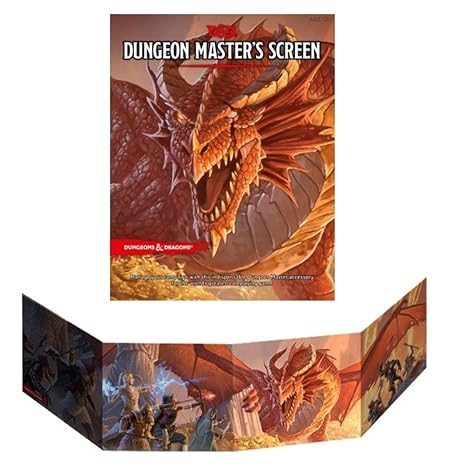
The official Wizards of the Coast DM screen is a rite of passage. Every dungeon master should own one at some point. The interior panels are packed with the most-referenced 5e tables — conditions, cover rules, encounter distances, skill checks — giving you instant access to the rules that come up most often mid-session. Slim, portable, officially licensed, and genuinely useful.

  • Official Wizards of the Coast D&D product
  • Interior packed with frequently-referenced 5e tables
  • Slim landscape format — doesn’t obstruct DM-player interaction
  • Durable card construction
  • The first DM screen most players encounter

🎭 The Official WotC Screen →


2. D&D Dungeon Master’s Screen: Dungeon Kit
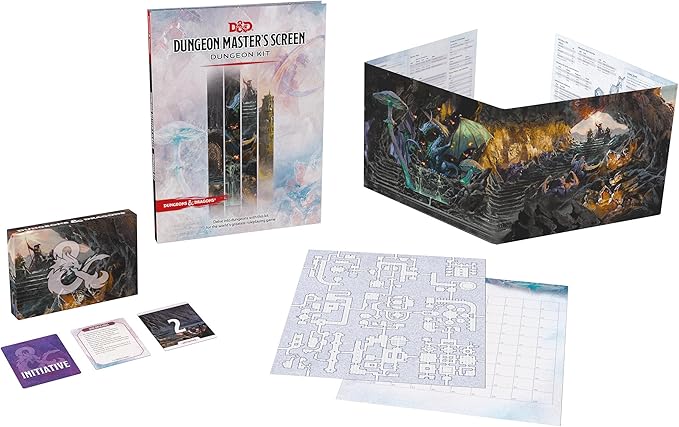
The Dungeon Kit takes the classic DM screen and upgrades it into a full dungeon-running toolkit. Alongside the screen itself, you get dungeon tiles, trackers, and extra reference material that transforms your DM workspace from a simple barrier into a fully operational command center. If you’re running dungeon-heavy campaigns, this set earns its keep every single session.

  • Includes DM screen plus dungeon tiles and trackers
  • Expanded reference content beyond the base screen
  • Great for dungeon-focused campaigns
  • Official D&D licensed content
  • Turns your DM space into a fully equipped workspace

🏰 Full Dungeon Kit →


3. CZYY DND DM Screen — Faux Leather Embossed Dragon & Mimic, 4-Panel
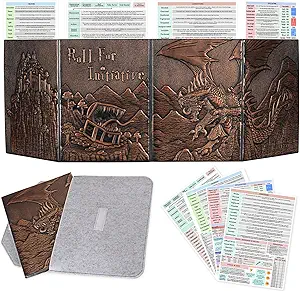
The CZYY Dragon & Mimic screen is the aesthetic upgrade your table deserves. Four panels of gorgeous faux leather with an embossed dragon on one side and a devious mimic on the other — because your players should never feel entirely safe about anything at your table. The built-in pockets let you slot in custom reference cards or notes, and the whole thing looks incredible whether open or closed on a shelf.

  • Four-panel faux leather construction
  • Embossed dragon and mimic exterior art
  • Built-in pockets for custom reference cards
  • Portrait orientation for extra height
  • Looks incredible on display between sessions

🐉 The Dragon Screen →


4. CZYY DND DM Screen — Faux Leather Embossed Cthulhu, with Inserts & Storage Case
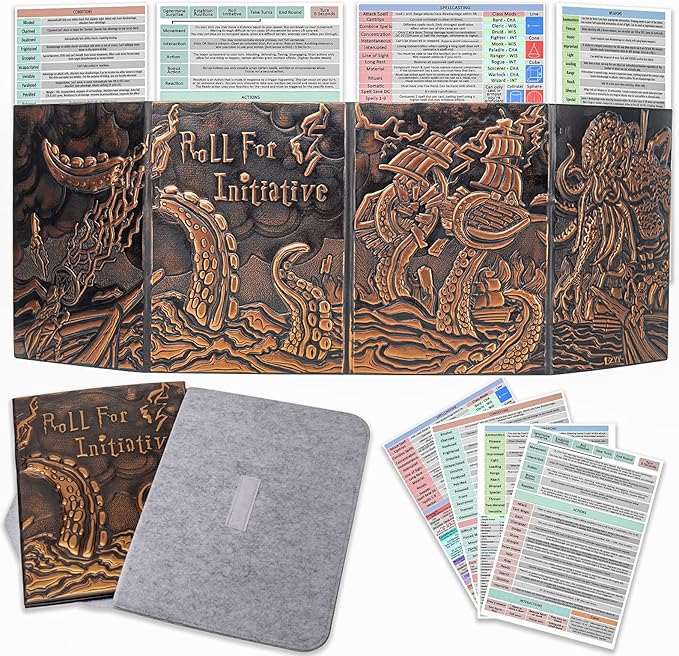
For the DM whose campaigns drift toward cosmic horror, the CZYY Cthulhu screen sets the perfect tone before a single word is spoken. The embossed Cthulhu exterior tells your players exactly what kind of session this is. Comes with interchangeable inserts so you can customize your reference panels, plus a storage case that keeps everything organized. A premium screen for premium dread.

  • Faux leather with embossed Cthulhu exterior art
  • Includes customizable interchangeable insert panels
  • Storage case included for organization
  • Four-panel portrait orientation
  • Perfect for horror, Lovecraftian, or dark campaigns

🐙 Embrace the Cosmic Horror →


5. Hexers Game Master Screen — 4 Customizable Panels, Dry Erase Tracker
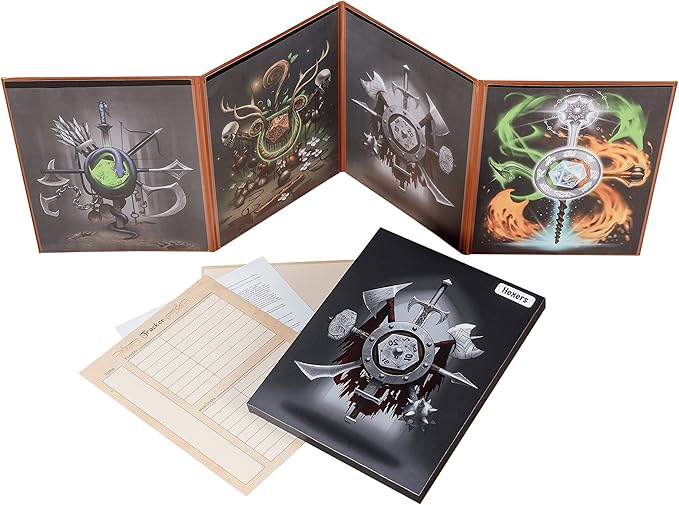
The Hexers GM Screen is the system-agnostic workhorse that belongs at every table regardless of what game you’re running. Four fully customizable panels mean you can slot in whatever reference tables serve your current system — D&D 5e, Pathfinder, Call of Cthulhu, whatever. The dry erase tracker panel is a game changer for managing initiative, conditions, and HP in real time. Practical, versatile, excellent.

  • 4 customizable panels — system agnostic
  • Dry erase tracker panel for real-time game management
  • Compatible with D&D, Pathfinder, and virtually any TTRPG
  • Insert your own custom reference cards
  • Durable construction built for regular use

🛠️ The Versatile Option →


🎁 One More Thing…

Game Master Essentials Roleplaying Starter Kit — Screen, Map Tiles, Dice & Trackers
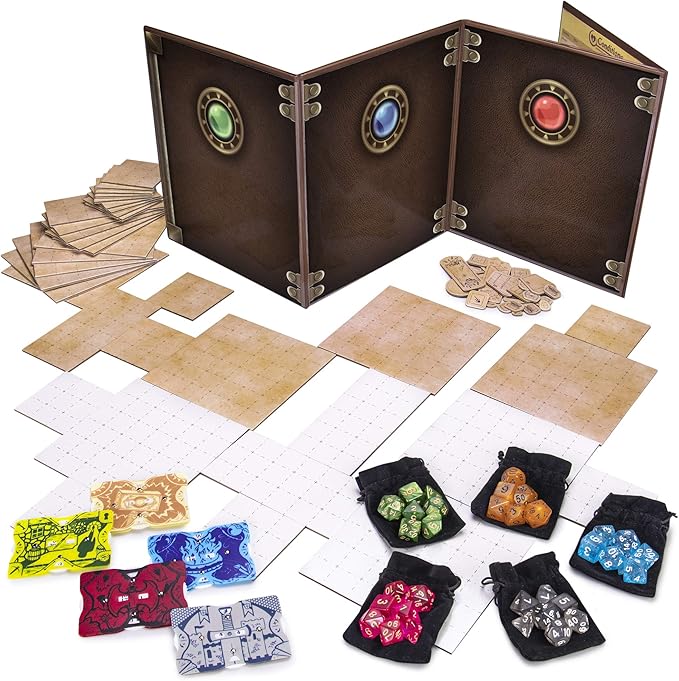
The ultimate bundle for a new DM who wants to hit the ground running. This kit packs a GM screen, 44 reversible map tiles, dice sets, and health trackers into one comprehensive package. Instead of hunting down four separate products to set up your first session, you open this box and you’re ready to run. If you know someone who wants to start DMing, this is the gift that removes every excuse.

  • Complete starter package: screen, tiles, dice, trackers
  • 44 reversible map tiles for flexible encounter design
  • Health tracker and condition reference tools
  • Dice sets included — everything in one box
  • Ideal gift for aspiring dungeon masters

🎁 The Complete Starter Kit →


Behind the screen, you are the architect of worlds. Set it up, take your seat, and let the adventure begin. Roll well, adventurer.

, , , , , , , , ,

How to Build a D&D Campaign Map From Scratch

A great campaign map is not about artistic skill. It is about making geographic decisions that make your world feel real — and leaving enough blank space for the campaign to breathe. Here is how to build one that will serve your table for years.

Start Small. Seriously.

The most common new DM mistake is mapping an entire continent before the campaign has run a single session. It is wasted effort — players will not visit 80% of it, and the story will pivot in ways that make carefully detailed regions irrelevant. Start with one town, a 50-mile radius, and a vague awareness of what lies beyond. Build outward only as the players travel. This approach keeps your prep efficient and gives the world room to evolve with the campaign.

Geography Before Everything

Place mountains and rivers before you draw a single settlement. Rivers flow downhill, always join at V-shaped junctions pointing downstream, and always end at a coastline or larger body of water. Mountain ranges run in chains parallel to coastlines. Highlands belong inland; lowlands near the sea. Settlements form at river junctions, natural harbors, and trade route crossings — put them there first.

This is not pedantry. Maps that follow real geographic logic feel organic in a way players immediately register, even if they cannot articulate why. When your world feels like a place that could exist, immersion follows naturally.

Name Locations as You Build

Do not place names as an afterthought. Name locations as you draw them. A mountain range name often triggers a lore idea. A river name suggests who settled along it and why. Many experienced DMs report their best story hooks arrived while staring at a half-finished map and asking: why is this place called that?

The Best Map-Making Tools in 2025

Inkarnate (inkarnate.com) is the best starting point for most DMs. Browser-based, thousands of assets for forests, mountains, buildings, and waterways, solid free tier, and a battle map tool built in. Learning curve is low and results look professional within an hour.

Wonderdraft is the choice for long-term campaigns. One-time purchase, no subscription. Procedural landmass generation plus manual brushes. A strong community asset ecosystem at cartographyassets.com provides thousands of additional assets. Supports spherical planet maps for DMs building entire worlds.

Azgaar’s Fantasy Map Generator is free and extraordinary for rapid prototyping. Input a seed, adjust parameters, and it generates a complete world with geography, cultures, religions, and trade routes in seconds. Use it to get a skeleton, then refine manually.

For organising everything else, World Anvil is the gold standard: lore, factions, NPC relationships, timelines, and campaign notes all linked and searchable. It can be overwhelming at first. Kanka is the more approachable alternative, with a generous free tier and unlimited campaigns.

Sandbox vs Authored: The Map Design Debate

The sandbox approach scatters points of interest and lets players choose where to go. Your map becomes a menu of options. Works best with procedural generation and a DM comfortable with improvisation. The authored approach plans specific story arcs and builds the map around them. More prep, more narrative control, higher chance of players going somewhere you actually designed.

The best approach for most DMs is both: a rough sandbox map with two or three “gravity wells” — locations with strong enough pull that players will eventually be drawn there regardless of their choices. This gives you the flexibility of a sandbox with the security of knowing the story has somewhere to go.

The Real Hot Take

A hand-drawn sketch with six location names and a river drawn in biro beats a Wonderdraft masterpiece you spent 20 hours building if the campaign never leaves the starting city. Build the map your campaign needs, not the map you wish the campaign would need. You can always add more. You cannot get those 20 hours back.

[Top]

The Best D&D Magic Items for Every Class

The right magic item does not just add numbers to a character sheet. It changes how a class plays, fills a gap in a party, or opens up a playstyle that was not possible before. Here are the best items by class, including several standouts from the 2024 Dungeon Master’s Guide.

Universal Picks (Good on Almost Anyone)

Bag of Holding — The iconic extradimensional storage item. Holds 400 lbs. Every party wants one and eventually needs one. Cloak of Protection — +1 to AC and all saving throws. Works on any class. The definition of a no-brainer item. Boots of Elvenkind — Silences your footsteps. Any stealth or highly mobile character will love this.

Fighter

Ring of Protection gives +1 to AC and saves and stacks with everything. A fighter with high AC and this ring becomes a legitimate wall. The new Executioner’s Axe from the 2024 DMG is available in multiple weapon forms, meaning a DM can tailor it to exactly the build in front of them. And never underestimate a straight +2 or +3 weapon: Fighters make more attacks than any other class, and every bonus point of damage on every hit compounds fast at high levels.

Rogue

The Cape of the Mountebank casts Dimension Door once per day — a 500-foot teleport. For a rogue, this is everything. Teleport in, land a Sneak Attack, vanish before anyone reacts. This is the fantasy the class was built for. For attack rolls, a +3 Weapon is essential: Sneak Attack damage only triggers on a hit, and the higher your chance to hit, the more reliably your primary class feature functions.

Wizard

The Staff of the Magi (Legendary) is the Wizard’s ultimate toy: 50 charges across 13 spells, +2 to spell attack rolls, advantage on saves against spells, and 6 free spells per day without touching the charge pool. The Tome of Vecna from the 2024 DMG doubles as both Spellbook and Arcane Focus, and lets the wizard cast any spell written in it as a Bonus Action once per day. One of the strongest new items in years.

Cleric

Mantle of Spell Resistance gives advantage on saving throws against spells. Clerics should not be on the front line, and protecting the healer from spell effects keeps them functional. For action economy, any item that lets a cleric cast Healing Word or Goodberry without spending spell slots is a force multiplier — it frees their actual slots for higher-impact spells.

Warlock

Rod of the Pact Keeper (+1) is the essential Warlock item: +1 to spell attack rolls and spell save DC, plus one spell slot recovery per short rest. The Warlock’s power is defined by their limited spell slots, and recovering one per short rest is genuinely impactful. The Robe of the Archmagi (Legendary) also works for Warlocks and Sorcerers and is tier-S at high levels.

Ranger

Scimitar of Speed grants a +2 weapon bonus and an additional melee attack as a Bonus Action. Rangers who build around melee will appreciate the extra hit. The Sentinel Shield gives advantage on initiative and Perception checks. Rangers win encounters by reacting first and spotting danger early — this item does both in one slot.

Barbarian

Adamantine Armor negates critical hits entirely — all crits become normal hits. Combined with a Barbarian’s already high HP pool and Rage damage resistance, this turns the class into something enemies struggle to put down. The Animated Shield is valuable for Barbarians who want to dual-wield: it floats independently and maintains the AC bonus without occupying a hand.

Paladin

Adamantine Plate for the same reason as Barbarian — a Paladin sitting in melee all session benefits enormously from eliminating crits. Add the Sentinel Shield for initiative and Perception advantage, and the Paladin becomes a reactive frontliner who rarely gets surprised and almost never goes down to a big hit.

Bard

The Lute of Thunderous Thumping adds 2d8 thunder damage on a hit. Under the 2024 rules, Bards can use Charisma for attack rolls, which means this weapon synergizes with the class’s primary stat perfectly. A Bard who wants to contribute in combat without burning spell slots will get consistent mileage out of this.

The 2024 DMG Difference

The 2024 Dungeon Master’s Guide quietly added some of the strongest and most flavourful new items in years. If your table is still running exclusively from the 2014 item list, it is worth checking what the new book brought. The Tome of Vecna and Executioner’s Axe alone are worth the look.

[Top]

The Best RPG Video Games to Play Right Now (2025-2026)

2025 was an extraordinary year for RPG video games. An indie studio from France came out of nowhere and swept every major Game of the Year award. Obsidian returned. Capcom hit its peak. Here is what to play right now and what to watch in 2026.

Clair Obscur: Expedition 33 — The Game of the Year

Nothing in 2025 came close. Sandfall Interactive, a French studio, released Clair Obscur: Expedition 33 and the gaming world stopped to pay attention. The premise: a mysterious figure called the Paintress paints a number at the start of each year, and everyone who has reached that age dies. You play as the 33rd Expedition, sent to stop her before she paints 32.

The combat is turn-based with real-time parry mechanics — described as Persona meets Sekiro — and it delivers on that description. The art direction is French belle époque crossed with dark surrealism. The storytelling punches well above the studio’s weight class. It won Ultimate Game of the Year at the Golden Joystick Awards, dominated the DICE nominations, and topped year-end lists at IGN, GameSpot, Game Informer, GamesRadar, Time, and Rolling Stone. It sold over 5 million units by October. An indie game. This is what happens when a smaller studio has something genuinely original to say.

Kingdom Come: Deliverance 2 — RPG of the Year Runner-Up

Not fantasy — but an extraordinary RPG. Set in 15th-century Bohemia with a level of historical authenticity that borders on obsessive. The quest design is among the best in any RPG released in years: consequences cascade across the game world based on your decisions in ways that feel organic rather than scripted. If you want a game that trusts you to navigate moral complexity without a waypoint marker telling you what to do, this is it.

Avowed — Obsidian Returns to Fantasy

Set in the Pillars of Eternity universe, Obsidian’s Avowed puts you in the role of an envoy investigating a plague spreading across the Living Lands. The combat blends melee and spellcasting in a first-person format. The writing is characteristically strong — Obsidian’s team knows how to build morally interesting factions. Not a game-of-the-year contender in a year with Clair Obscur, but a solid, mature fantasy RPG from one of the genre’s most reliable studios.

Monster Hunter Wilds — Action RPG at Its Peak

Capcom’s Monster Hunter series at its most polished and accessible. The action RPG loop — hunt monsters, harvest parts, craft better gear, hunt bigger monsters — has never felt this smooth. The environmental storytelling around the game’s ecosystem is genuinely impressive. If you have never played Monster Hunter, Wilds is the best possible entry point.

Standout Indie RPGs of 2025

Look Outside deserves mention: a survival horror RPG set inside an apartment building after an event makes it literally impossible to look outside. Claustrophobic, creepy, and deeply atmospheric. For fans of GoblinScape’s dark fantasy aesthetic, this one will land.

What to Watch in 2026

  • Fable — The long-awaited reboot. High anticipation, no confirmed release window. Could be the year’s biggest RPG if it delivers.
  • The Blood of Dawnwalker — Dark fantasy action RPG. One to watch closely.
  • Crimson Desert — Open world fantasy RPG from Pearl Abyss with substantial production values.
  • Deltarune Chapter 5 — Toby Fox’s beloved RPG series, expected late 2026.

The Takeaway

Clair Obscur: Expedition 33 proved that the most important RPG of 2025 did not come from a major publisher. The indie RPG space is producing work that AAA studios cannot match on storytelling and vision. Play it if you have not. Then come back for the 2026 list.

[Top]

Pathfinder 2e vs D&D 5e in 2025: Which Game Is Right for Your Table?

Two games dominate the tabletop RPG space. One is the most popular TTRPG ever made. The other is arguably the better-designed game. Here is an honest comparison of where each stands in 2025.

The Community Size Reality

D&D 5e is the juggernaut. Dominant at game stores, dominant on Roll20 and D&D Beyond, dominant in the cultural conversation. If you post a “looking for players” notice anywhere online, the pool of people who know D&D dwarfs the pool who know Pathfinder. That network effect is a genuine advantage that no mechanical argument can fully overcome.

Pathfinder 2e has a smaller but intensely passionate community. PF2e players tend to produce detailed optimisation guides, system mastery resources, and community tools at a high rate relative to community size. The discourse is technical and enthusiastic. These are players who chose the harder game deliberately.

The Key Mechanical Differences

The two games make fundamentally different design choices at almost every level:

Actions

D&D 5e gives you an Action, a Bonus Action, and Movement. Most characters use this the same way every turn. Pathfinder 2e gives you three actions and lets you spend them however you choose — three attacks (with escalating penalties), two attacks and a spell, a move and two actions to cast something powerful. The three-action system rewards tactical thinking and makes every turn a decision.

Customisation

In D&D 5e, feats are optional and arrive every four levels. In Pathfinder 2e, you gain a feat — ancestry, class, or skill — at almost every level. Character customisation in PF2e is a different order of magnitude. A level 10 Pathfinder character has made dozens of meaningful choices. A level 10 D&D character has made a handful.

Scaling

D&D uses bounded accuracy: bonuses stay in a tight range (+5 to roughly +11 at level 20). This keeps lower-level enemies relevant. Pathfinder scales aggressively — proficiency adds to everything, and a high-level character feels genuinely more powerful than a low-level one in ways that 5e intentionally softens.

Critical Hits

In D&D, any natural 20 is a critical hit regardless of AC. In Pathfinder, you critically succeed when you exceed a DC or AC by 10 or more — a meaningful distinction that rewards precision play and AC investment.

Who Each Game Is For

D&D 5e is the right choice if: You are introducing new players to TTRPGs. Your group prioritises storytelling and improvisation over mechanical precision. You want to find replacement players easily. You want the largest possible library of official and third-party content.

Pathfinder 2e is the right choice if: Your group loves mechanical depth and character optimisation. You want combat decisions to feel genuinely tactical. You migrated from 3.5e or PF1e and miss that level of crunch. You want a game where system mastery is rewarded over time.

The Hot Take

Pathfinder 2e is arguably a better-designed game. The three-action system is elegant. The scaling is coherent. The feat system gives meaningful choice at every level. The critical success and failure system creates drama without randomness. But D&D wins on accessibility and network effect, and those things matter. Your players have heard of D&D. Your FLGS runs D&D. The cultural gravity of D&D is real and it still pulls. Both games are worth your time. The question is which one your table will actually play.

[Top]

How to Design a D&D Dungeon That Players Will Remember

Most published dungeons are corridors leading to rooms leading to fights. Great dungeons are something else: they are environments that tell a story, reward curiosity, and make every room feel like a consequence of the dungeon’s history. Here is how to build one.

Start With History, Not Layout

Before drawing a single room, answer three questions. Who built this dungeon and why? What happened to them? What moved in after they left? A dwarven mine that became a lich’s tomb that became a goblin warren has three eras of architecture, design logic, and clutter. Each layer tells a story. Players who pay attention will piece it together, and that discovery is its own reward.

The 5-Room Dungeon Framework

The most cited structure in dungeon design for good reason. It works whether you are building a two-hour one-shot or a single floor of a larger megadungeon:

  1. Entrance with a guardian or obstacle — Sets tone and filters unprepared parties.
  2. Puzzle or roleplay challenge — Breaks up combat, rewards lateral thinking.
  3. Red herring or trick room — Keeps players alert. Not everything is what it appears.
  4. Climax and boss encounter — The payoff. Should feel earned.
  5. Reward and revelation — Loot is the obvious part. The revelation — a piece of lore, a map, a clue — is what makes the dungeon matter to the campaign.

Five rooms is a minimum, not a ceiling. Use this as a skeleton and expand from it.

Jaquay the Dungeon

The principle named after game designer Jennell Jaquays: a dungeon should have loops, multiple paths, multiple entrances, asymmetrical design, secret doors, and shortcuts. Linear corridors — room A leads to room B leads to room C — feel like hallways, not places. An interconnected layout with player choice embedded in navigation turns movement through the dungeon into a game in itself.

Every Room Needs Thematic Clutter

Empty rooms are dead rooms. Every space should answer: who used this, what happened to them, and why is it dangerous now? Rusted weapons. Half-eaten rations. A shrine to a god no one worships anymore. Scorch marks on the wall at head height. Signs of previous occupants — adventurers who did not make it, monsters that moved on, ancient inhabitants who left traces — make dungeons feel inhabited rather than constructed for the party’s benefit.

Design Traps That Reward Attention

Traps should feel like something the dungeon’s creator would actually have built. A mad wizard’s tower has different traps than a dwarven vault. The best traps present a visible warning: scorch marks near a fire trap, a wet floor near a pit, bones scattered in a specific pattern. Players who pay attention should be rewarded. Players who rush should be punished. Blind gotcha traps that kill characters with no warning are just DM cruelty with extra steps.

Pace the Encounters

Never stack combat back to back. Players burn out and combats lose meaning when there is no breathing room between them. A strong rhythm: exploration room, combat encounter, trap or puzzle, exploration, boss fight. The Kobold Press Campaign Builder reinforces this principle: the pacing within a dungeon is as important as the design of individual rooms.

The Hot Take: Build Less, Build Better

Most new DMs overbuild. A 30-room dungeon with 20 mediocre rooms beats nothing — but a 5-room dungeon where every room is memorable, purposeful, and connected to the campaign’s themes beats both. Constraints force creativity. Start with five rooms. Make each one count. Expand only if the campaign demands it.

[Top]

The Best D&D Adventure Modules to Buy in 2025 (And One to Avoid)

With hundreds of published D&D adventures to choose from, picking where to spend your money is harder than it should be. Here is an honest breakdown of the best modules available right now — and a frank assessment of the biggest recent release.

Curse of Strahd — Still the Best Module Ever Made

Published in 2016. Still the community’s unanimous pick for the greatest official D&D adventure ever written. That is not nostalgia talking — it is the result of a module that does things most published adventures still fail to do: it functions as a true sandbox. Barovia is a living, breathing, cursed world. Strahd reacts to the players. Encounters, secrets, and narrative threads shift based on what the party does. Nearly a decade after release, it beats every new product on the market on almost every metric. If you own one official campaign, make it this one.

Tomb of Annihilation — High Lethality Done Right

A jungle hexcrawl on the peninsula of Chult, dripping with death. A death curse is spreading across the Forgotten Realms, and the party has to find its source before they dissolve into nothing. What follows is dinosaur hunting, trap-laden ruins, a lich with a god complex, and a dungeon that will end characters. The high-lethality tone is deliberate and the module commits to it fully. For groups that want their campaign to have genuine stakes, Tomb of Annihilation delivers.

Lost Mine of Phandelver — The Best Starter Adventure

The community’s consensus pick for the best introductory module, and it has held that title for years. The scope is tight, the encounters are well-designed, the main villain is genuinely threatening without being overwhelming, and it teaches both players and DMs the fundamentals of 5e without drowning them. If you are running D&D for the first time or introducing new players, start here.

Keys from the Golden Vault — The Underrated Pick

Thirteen heist-themed one-shot adventures across levels 1 to 11, each built around a distinct caper. The format is clever: players receive a player-facing mission briefing map while the DM works from a separate battle map. It rewards planning, lateral thinking, and creative problem-solving over combat. The community consistently rates it above other recent anthology releases. If your group has ever wanted to pull an Ocean’s Eleven in D&D, this is the module for it.

Vecna: Eve of Ruin — An Honest Assessment

The biggest 2024 release. Levels 10-20. Vecna tries to destroy the gods. On paper, a spectacular premise for a capstone campaign. In practice, the community verdict has been mixed to negative. The set pieces are individually impressive, but the plot does not hold together as a coherent campaign. A late-game twist undermines player agency in ways that generated significant backlash. Experienced DMs who are prepared to heavily rewrite the connective tissue report having a great time. DMs running it as written report frustration. Approach with a heavy editing hand or skip it.

Journeys Through the Radiant Citadel — For Variety

Thirteen standalone adventures, levels 1 to 14, each drawing from a distinct cultural tradition beyond the standard Western European fantasy template. The adventures can be woven into a larger campaign or run independently as one-shots. The quality varies between entries but the best are genuinely excellent. A strong pick for groups that want cultural variety and a DM who wants flexible one-session options.

The Bottom Line

The best D&D adventure money can buy in 2025 was published in 2016. Curse of Strahd remains the gold standard, and nothing released since has definitively beaten it. Buy that first. Then buy Tomb of Annihilation if you want to scar your players.

[Top]

Every Major D&D Campaign Setting Ranked: From Forgotten Realms to Dark Sun

D&D has produced some of the most imaginative campaign settings in the history of tabletop roleplaying. It has also buried most of them under an avalanche of Forgotten Realms content. Here is an honest assessment of every major setting — what makes each one work, what holds it back, and which one is right for your table.

Forgotten Realms — S-Tier for Accessibility, Divisive for Originality

The default. More officially published content exists for the Forgotten Realms than all other D&D settings combined. Baldur’s Gate 3 gave it a massive cultural moment that is still reverberating. The 2025 double release of Heroes of Faerun and Adventures in Faerun is the most expansive setting treatment WotC has produced in years.

The criticism is fair: Forgotten Realms can feel safe. The Tolkien-adjacent high fantasy aesthetic is familiar to the point of genericness for players who want something distinctive. If you are introducing someone to D&D, start here. If you are an experienced player looking for something that challenges your assumptions about what a fantasy world can be, look elsewhere.

Eberron — A-Tier: The Thinking Player’s Setting

Eberron won a WotC setting creation contest during third edition and has been a fan favourite ever since. Deliberately not Tolkien — draws from noir detective fiction, pulp adventure, and Casablanca. Magic functions as industrialised technology: lightning rail trains, magical airships, sentient warforged soldiers left over from a century-long war. Morality is explicitly grey — there was no good side in the Last War.

2025 news: Eberron: Forge of the Artificer is coming with a revised Artificer class, revised Dragonmarks, and three campaign outlines. Major for Eberron fans who felt the 5e sourcebook was thin. If you want D&D that feels like a completely different genre, Eberron delivers.

Ravenloft — A-Tier: Best for Dark Fantasy

For this site’s audience, Ravenloft is the most relevant setting on this list. Gothic horror. Existential dread. The horror of the human condition rather than the horror of the monster. The Domains of Dread are pockets of nightmare reality, each ruled by a Darklord — a powerful figure trapped in ironic, endless punishment by the mysterious Dark Powers.

Strahd von Zarovich is the most famous villain in all of D&D — a vampire who lost his humanity pursuing an obsession, now cursed to reign over a domain that is as much a mirror of his grief as it is a prison. Curse of Strahd is widely considered one of the best published campaigns ever written for any edition of the game. The 2021 Van Richten’s Guide to Ravenloft expanded the setting significantly.

Hot take: Ravenloft is objectively the best setting for dark fantasy storytelling, and it is the most underserved by WotC’s publishing output. Forgotten Realms gets the budget. Ravenloft gets the cult following. The cult following is right.

Dark Sun — S-Tier Concept, Zero Current Support

Dark Sun is D&D’s post-apocalyptic desert wasteland. Think Dune crossed with Mad Max, not Middle Earth. Magic users called Defilers literally drain life from the environment to cast spells — forests die when powerful wizards act. Slavery is systemic. Water is currency. The gods are mostly dead or absent.

It has not received a 5e sourcebook. WotC has been openly cautious about Dark Sun’s thematic content in the current cultural climate. But August 2025 brought a significant signal: an Unearthed Arcana playtest titled “Apocalyptic Subclasses” directly referenced Dark Sun lore — Circle of Preservation Druid, Gladiator Fighter, Defiled Sorcery Sorcerer, Sorcerer-King Patron Warlock. A 5e Dark Sun book is looking more plausible than it has in years. The community is watching.

Spelljammer — C-Tier Execution, S-Tier Concept

D&D in space. Ships sailing the Astral Sea between crystal spheres containing solar systems. Bizarre alien races, cosmic horror, wildspace whales. Genuinely fascinating lore. When the 2022 Adventures in Space box set arrived, the community was largely disappointed — thin content, high price for three slim books, and a controversial decision to quietly remove a Dark Sun reference that had been teased. The concept deserves better than the execution received.

Greyhawk — B-Tier: Where D&D Was Born

Gary Gygax’s original setting. Deeply embedded in D&D history — the Temple of Elemental Evil, the City of Greyhawk, the World of Oerth. A new sourcebook is reportedly in development. Matters enormously to old-school players. Less resonant for audiences who came to D&D through Baldur’s Gate 3 or fifth edition.

The Verdict

For new players: Forgotten Realms. For players who want tactical intrigue and moral complexity: Eberron. For dark fantasy, gothic horror, and the best villain in the game’s history: Ravenloft. For the most daring, distinctive, and currently unsupported setting in D&D history: Dark Sun — and if the Unearthed Arcana signals are right, its moment may finally be coming.

[Top]

How to Write Dark Fantasy Lore That Actually Lands

Dark fantasy is not regular fantasy with the lights off. It is a fundamentally different mode of storytelling — one where the world resists easy resolution, magic extracts a price, and the most compelling characters operate in shades of grey that no alignment chart can capture. Here is how to write it well.

Atmosphere Is Your Primary Instrument

In dark fantasy, atmosphere is not backdrop — it is content. The crumbling watchtower, the fog-shrouded moor, the forest that feels like it is watching: these are not set dressing. They are doing narrative work. Everything in your prose — sentence length, word choice, pacing, the physical details you choose to render — should serve the mood.

But here is the trap most writers fall into: monotonous oppression. If everything is grim all the time, nothing reads as grim — it just reads as flat. Contrast is your most powerful tool. A moment of genuine warmth, beauty, or connection makes the darkness that follows land ten times harder. Let your characters have something worth losing.

Dark Magic Must Cost Something Real

This is the single most cited principle across every dark fantasy writing resource, and it is cited that often because it is that important. If magic is free and limitless, it loses its menace. The moment characters can solve any problem by casting the right spell at no cost, your world loses its teeth.

Dark magic should exact a price: physical deterioration, mental corruption, spiritual erosion, moral compromise, shortened lifespan. The cost should be visible. Characters who use dark magic should change — incrementally, irreversibly. The power is seductive precisely because the cost is real and the person paying it can feel themselves changing. Dark Sun handles this best of any D&D setting: Defiler wizards literally drain life from the environment, leaving ash where living things stood. Every spell has a scar on the world.

Moral Ambiguity Is Not Optional

Flat good versus evil is regular fantasy. Dark fantasy demands characters who operate in the space between. Your villain should have motivations that are comprehensible — grief, survival, betrayal, a wound that never healed. Your hero should have done things they cannot justify and cannot undo. The moral weight of those choices should persist. Characters who do terrible things for good reasons and good things for terrible reasons are the engine of dark fantasy narrative.

Study Joe Abercrombie’s First Law trilogy for moral ambiguity at scale. Study Andrzej Sapkowski’s Witcher for the psychological consequences of violence on a protagonist who has been killing monsters — human and otherwise — for decades. Both writers understand that the most unsettling thing in dark fantasy is not the monster. It is the person who became capable of fighting it.

Build the World Through the Senses

The worst dark fantasy lore dumps arrive as encyclopaedias. Pages of history, taxonomy, cosmology, political structure — information delivered like a briefing, not a story. The alternative: show your world through sensation. The smell of decay in a cursed forest. The temperature drop as a character enters a haunted corridor. The sound of something moving in the dark just outside the torchlight. Let readers infer the rules of your world from what characters experience, not from what the narrator explains.

The iceberg principle applies here directly: 90% of your lore should never appear on the page. But its weight should be felt in every scene. Choose which systems — magic, religion, political history, creature taxonomy — get deep development, and resist the urge to show all your work.

Pace for Dread, Not for Shock

Horror in dark fantasy works through slow accumulation. A single image. A recurring motif — a symbol, a sound, a colour that appears at the edges of scenes. A character noticing something wrong and not being able to say what. When violence or horror finally arrives, it should feel inevitable, not gratuitous. The reader’s imagination will build something worse than anything you describe explicitly. Trust that. Suggestion and implication are more powerful than graphic detail.

The Reference Points Worth Studying

If you are building dark fantasy lore — for a campaign, a novel, a game, or a world — study these: Joe Abercrombie for moral ambiguity at scale. Andrzej Sapkowski for consequences of violence on character psychology. Glen Cook’s Black Company for war as grinding, unglamorous horror. The Souls series for environmental storytelling and lore delivered through fragments rather than exposition — every item description and piece of architecture is doing narrative work. Dark Sun for a magic system with genuine ecological consequences.

Good dark fantasy lore does not explain the darkness. It makes you feel it.

[Top]

The Best Tabletop RPG Accessories in 2025: Dice, Mats, Screens, and Minis

Your character sheet is ready. Your campaign is prepped. Now let’s talk about the gear that makes the table feel like an actual adventure. Here’s what’s worth buying in 2025.

Dice: Where to Spend Your Gold

The dice market has exploded. Here are the brands worth knowing:

  • Mystery Dice Goblins — Tops multiple best-of lists. Known for creative designs and innovative sets that go beyond standard acrylic.
  • Dicebound — A rising star. Their second Kickstarter funded in under 30 minutes and raised over 00K. Watch this brand.
  • DNDND — Thematic sets based on mythical creatures, ancient runes, and cosmic themes. Available in resin and metallics. Great aesthetic range.
  • Beadle & Grimm’s — Premium class-specific dice sets for D&D 5e. Expensive, but genuinely beautiful.
  • Die Hard Dice — The reliable workhorse brand. Consistent quality, huge variety, well-priced.

What’s trending: Liquid core dice — sets with swirling liquid trapped inside — are the current premium obsession. Also popular: dice with real dried flowers, metallic foil, or glitter suspended in resin. Pricing runs from for quality acrylic sets to 5+ for liquid core or solid metal.

Battle Mats: The Foundation of Your Table

A good battle mat transforms combat from abstract to tactical. The best options right now:

  • Loke Battle Mats — Their modular “Books of Battle Mats” connect together to create large, varied terrain layouts. Their 2025 Terrain Set added reusable scenery stickers — a genuinely clever innovation.
  • Melee Mats — Praised for durability and grid quality. A strong all-rounder.
  • TidyBoss — Budget-friendly double-sided 24×36 mat with multiple terrain types and included dry-erase markers. The best value option.

Material matters: neoprene is the preferred choice for durability and a non-slip surface. Most mats now come double-sided with both hex and square grids, which covers every game system you’re likely to run.

GM Screens: The World’s Greatest Screen (Still)

Hammerdog Games’ World’s Greatest Screen has been the gold standard for customisable GM screens for over a decade and nothing has displaced it. The design is simple and brilliant: laminate pockets let you slide in your own reference sheets, player-facing art, or encounter tables. It supports wet and dry erase markers, comes in portrait and landscape orientations, and is available in multiple colours including black and purple — ideal for dark fantasy tables. If you don’t own one, fix that.

For DMs who want everything in one unit, all-in-one modular systems from Etsy makers are growing in popularity: combos that include dice tower, battle map, combat tracker, dice box, miniature storage, and GM screen in a single collapsible structure. Higher cost, but spectacular table presence.

Miniatures: The 3D Printing Revolution

This is the biggest shift in the accessories market. Resin 3D printers — particularly the Elegoo Saturn 4 Ultra and Creality HALOT-MAGE S 14K — now produce miniatures with layer resolution so fine they’re essentially indistinguishable from commercially cast minis. Platforms like MyMiniFactory and Printables offer thousands of free and paid models.

The practical result: many dedicated players now print everything and buy almost nothing retail. WizKids, the dominant pre-painted miniature brand, is under real market pressure for the first time.

If you’re not ready to invest in a printer, the traditional options remain solid:

  • WizKids — Pre-painted, ready to use, widely available. Great for casual players.
  • Wargames Atlantic — High-quality unpainted minis at genuinely accessible prices.
  • Modiphius — Premium unpainted minis for serious painters.

For painters, the Redgrass RGG360 Painting Handle Kickstarter raised 3K in 2025 — evidence that the miniature painting accessory market is thriving alongside the printing revolution.

The Bottom Line

You don’t need any of this to play D&D. A pencil, a character sheet, and a set of dice will get you through. But the right accessories make the table feel like a place worth gathering around — and that matters more than any single stat block or encounter design tip. Invest in what serves your table, not what looks good on a shelf.

[Top]